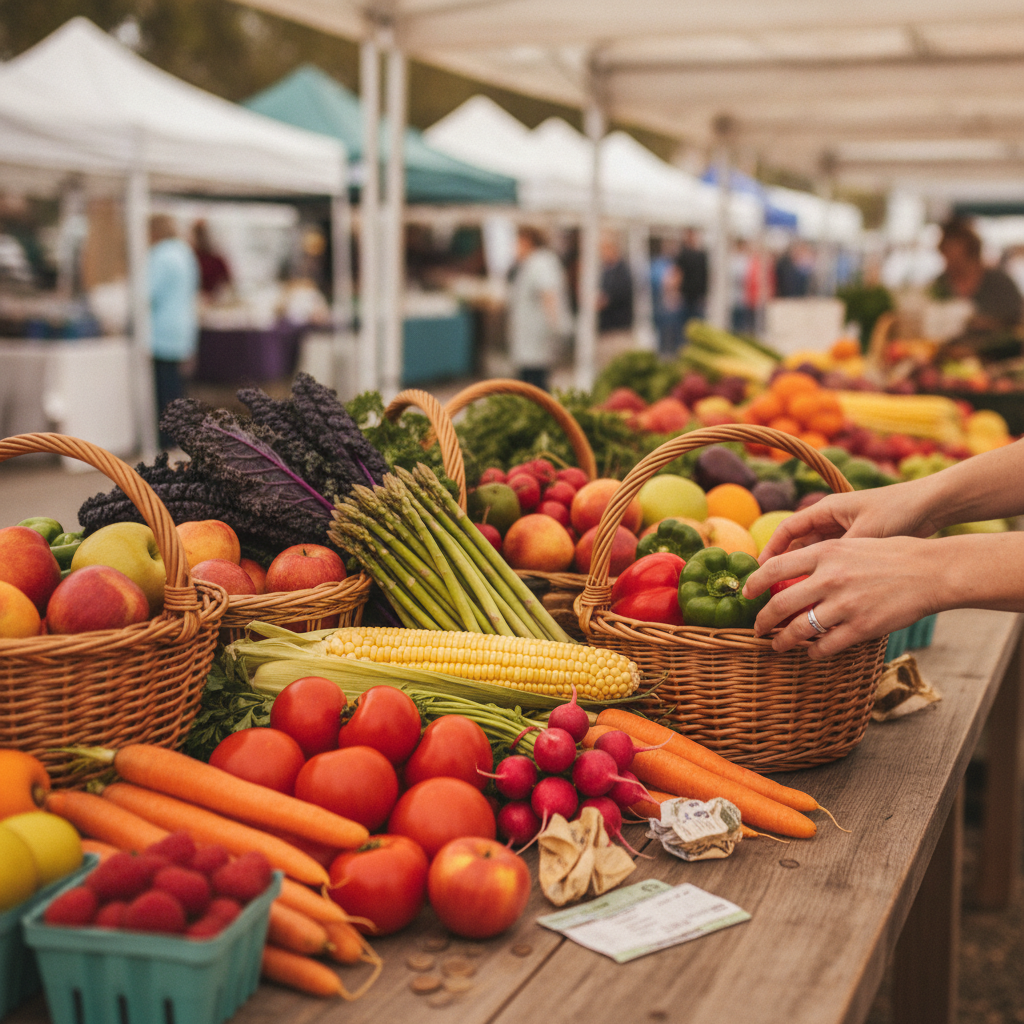
There is a particular kind of arithmetic that happens at a farmers' market — one that doesn't show up on a receipt but accumulates steadily over time. A shopper walks past a table piled with summer squash or late-autumn sweet potatoes and pays a price that feels, somehow, both fair and generous. No clipping, no app-scanning, no waiting for a sale cycle. The savings are embedded in the season itself, and that's a mechanism that coupon culture has never quite replicated.
The True Cost Structure of Seasonal Buying
Conventional grocery stores operate on a year-round inventory model, which means that strawberries appear in January and butternut squash sits on shelves through June. That convenience carries a price — not just in dollars, but in the layers of cold storage, long-haul freight, and distribution infrastructure that get folded into every sticker price. When a shopper buys a flat of peaches at a farmers' market in late summer, they're purchasing something that was likely harvested within the last 48 hours and traveled fewer than a hundred miles. The absence of that supply chain overhead is precisely why prices at markets like the Ferry Plaza Farmers Market in San Francisco or the Green City Market in Chicago can undercut supermarket rates on peak-season items by a meaningful margin — sometimes dramatically so.
Coupons, by contrast, work within that same supply chain structure. They reduce the retail markup slightly, but the base cost of off-season or industrially grown produce remains baked in. A coupon for a dollar off bagged salad greens is still anchored to a price inflated by refrigerated trucking from Arizona in February. Seasonal buying at a local market sidesteps that anchor entirely.
What "Eating with the Season" Actually Means
The phrase *mangiare con le stagioni* — Italian for "eating with the seasons" — captures something that European food cultures have long treated as common sense rather than a lifestyle choice. It describes a rhythm of consumption that follows what the land is actually producing at any given moment, rather than what a supply chain can artificially provide. In practical terms, this means eating asparagus in spring, tomatoes in high summer, root vegetables in fall, and citrus and storage crops through winter. The rhythm isn't restrictive so much as it is orienting — it gives the weekly food budget a natural structure.
For budget-conscious shoppers, that structure is genuinely useful. When a vegetable is at peak season, local supply is abundant and prices drop accordingly. A vendor at a Saturday market in Portland's PSU Farmers Market isn't holding inventory or paying for climate-controlled storage — they need to move what they grew, and that urgency tends to benefit buyers. Purchasing a surplus of peak-season produce and preserving it — through freezing, pickling, or simple refrigeration — extends those savings further into the year without requiring any promotional timing or loyalty app.
Why Coupons Have a Ceiling That Seasons Don't
Couponing is a legitimate and often effective savings strategy, but it operates within a fixed range. A coupon reduces a price; it doesn't change the underlying cost model that generated that price. Dedicated coupon users often report meaningful savings on packaged and processed goods, but fresh produce — particularly at the quality level found at regional farmers' markets — rarely enters the coupon ecosystem at all. The economics of small-scale farming simply don't support a manufacturer-coupon model.
Seasonal buying at a local market, on the other hand, functions more like a structural discount. The savings aren't contingent on a brand's marketing calendar or a retailer's inventory strategy. They're the natural result of buying something when and where it's most abundant. Over the course of a year, a household that shops seasonally at a farmers' market for even a portion of its produce needs will spend less per nutritional unit than one relying on grocery store produce plus coupons — not because of any particular discipline or effort, but because the cost structure is fundamentally different.
Building a Market Habit That Holds
The challenge with farmers' markets isn't philosophical — it's logistical. Most operate once or twice a week, often on Saturday mornings, which requires a degree of planning that the 24-hour supermarket doesn't. The shift requires thinking about the week's meals before the week begins, which is actually a secondary savings mechanism: meal planning consistently reduces food waste, and food waste is one of the quietest budget leaks in most households.
Apps like Farmish and local CSA (Community Supported Agriculture) subscription services can bridge the gap between market days, delivering seasonal boxes directly to a household on a predictable schedule. A CSA share functions like a produce subscription — you pay upfront for a season's worth of weekly boxes, which locks in low harvest-season pricing and removes the weekly decision-making entirely. For households that find the market timing difficult to maintain, a CSA is often the more sustainable option.
Rethinking What "Value" Means at the Register
For you, the shift toward seasonal market buying may feel like a lifestyle upgrade dressed in savings language — and that tension is worth sitting with rather than resolving too quickly. The produce is fresher, the varieties are often more interesting, and the act of choosing food that was grown nearby carries a kind of satisfaction that a discounted bag of pre-washed spinach does not. But the financial case stands on its own. Spending less per pound on tomatoes in August than in March isn't a luxury — it's just accurate timing.
The shopper who began this piece walking past a table of summer squash wasn't making a sacrifice or following a trend. They were participating in an old logic — older than coupons, older than supermarkets — that prices food according to what the earth is actually doing. That logic, it turns out, is also one of the most reliable savings strategies available.