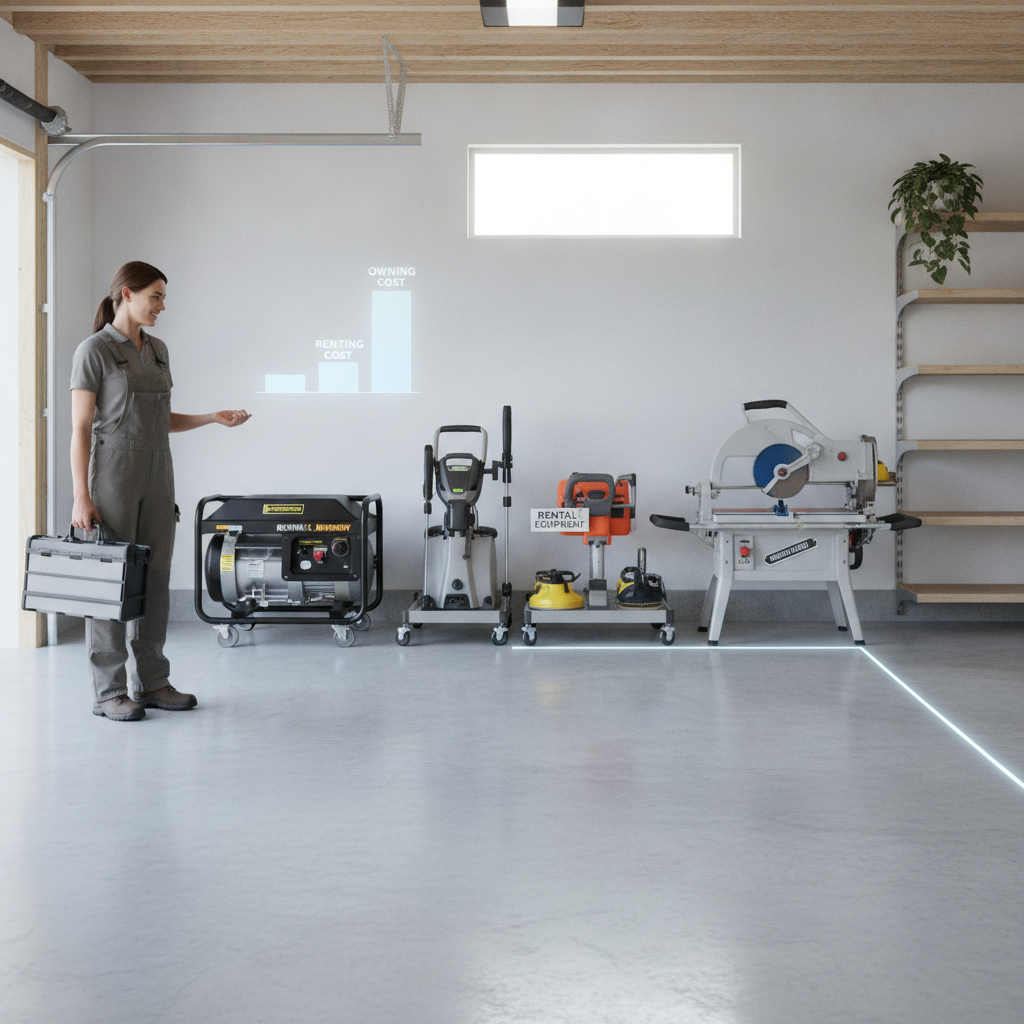
There's a particular kind of clutter that lives in garages and storage rooms across the country — the kind made up of tools bought for one project and never touched again. A tile saw from a bathroom renovation three years ago. A power washer used twice. A ladder that barely fits anywhere and gets knocked over every time you reach for something else. Owning equipment you rarely use isn't just a storage headache; it quietly costs you more than you'd expect. Renting, on the other hand, is one of the most underrated ways to keep both your space and your wallet in better shape.
The Real Cost of Owning Things You Barely Use
When you buy a tool, the purchase price is just the beginning. Storage space has real value — whether you're paying for a larger home, a storage unit, or simply losing usable square footage. Maintenance, replacement parts, and the occasional repair add up over time. And for anything motorized, there's the slow degradation of sitting unused for months on end. When you rent, you pay for exactly what you need, and then you hand it back. No upkeep, no storage, no wondering if the battery still holds a charge.
Rental Services Have Gotten Surprisingly Convenient
The rental market for tools and equipment has expanded well beyond the traditional hardware store counter. Places like Home Depot and Sunbelt Rentals offer same-day pickup on hundreds of items, from pressure washers to concrete mixers. Peer-to-peer platforms like Lowe's Tool Rental and local equipment libraries have made the process even more accessible. In many cities, you can reserve online, pick up within the hour, and drop off the next day. The friction that once made renting feel inconvenient has mostly disappeared.
Identifying Which Tools Are Worth Renting
The practical rule is straightforward: if you'd use something fewer than a handful of times a year, it's a strong candidate for renting rather than buying. Specialty tools fall into this category almost automatically — think floor sanders, tile saws, pipe threaders, or stump grinders. Seasonal equipment like aerators and dethatchers for lawn care are perfect examples. Even higher-end pressure washers and steam cleaners, which many households buy impulsively, get used so infrequently that renting them costs a fraction of what ownership does over a few years.
How Renting Protects You from Depreciation
Tools and equipment lose value quickly, especially power tools and anything with a motor. When you buy a piece of equipment, you're absorbing that depreciation the moment you leave the store. If your needs change — a different project calls for a different tool, or you move to a home with different requirements — you're either stuck with something you can't sell for much, or you spend time trying to offload it. Renting sidesteps this entirely. You get full use of a well-maintained machine and walk away without any residual liability.
Renting Before Buying Is a Smart Test Drive
One of the most practical benefits of renting is that it lets you evaluate a tool before committing to ownership. If you're genuinely considering buying a specific type of miter saw or a high-end pressure washer, renting one first gives you real hands-on experience. You find out quickly whether you'll actually use it, whether the size works for your space, and whether a cheaper model might do the job just as well. It's a low-stakes way to make a smarter purchasing decision, rather than relying on reviews alone.
The Space Dividend Is More Valuable Than It Looks
Freeing up storage space has compounding benefits that are easy to underestimate. A garage that isn't crammed with rarely-used equipment becomes functional again — for parking, for hobbies, for a workspace. That reclaimed space can eliminate the need for a storage unit, which typically runs a meaningful monthly cost. For apartment dwellers or those in smaller homes, the space savings are even more significant. Less clutter also means less stress, and the general quality of a living environment improves when the spaces around you aren't overflowing with things that have no regular purpose.
Building a Habit Around the Rent-First Mindset
Shifting toward renting requires a small change in default thinking. The instinct to buy is deeply ingrained — owning something feels more certain, more permanent. But for low-frequency equipment, that certainty comes at a cost. A practical approach is to ask one simple question before any tool purchase: how many times will I realistically use this in the next two years? If the answer is fewer than five or six times, the math almost always favors renting. Platforms like Neighbor and Fat Llama have also made it easier to rent from individuals nearby, which often comes with lower rates and more flexibility.
When Ownership Still Makes Sense
Renting isn't always the right answer, and it's worth being honest about that. Tools you genuinely reach for every month — a drill, a basic circular saw, a reliable level — are worth owning outright. The crossover point is frequency and predictability. If something is part of your regular routine or ongoing maintenance, buying a quality version makes more financial sense than paying rental fees repeatedly. The goal isn't to avoid ownership entirely; it's to stop defaulting to buying things simply because buying feels like the responsible, prepared thing to do.
Renting rarely-used tools and equipment is one of those practical habits that pays off in multiple directions at once — lower costs, more space, and less of the low-level burden that comes from owning things you don't really need. The rental market has made this approach easier and more affordable than ever, so the barriers that once made buying feel like the only sensible option have largely fallen away. Treating ownership as something you earn through genuine, repeated use — rather than something you default to — is a simple shift that quietly improves both your finances and your living space over time.