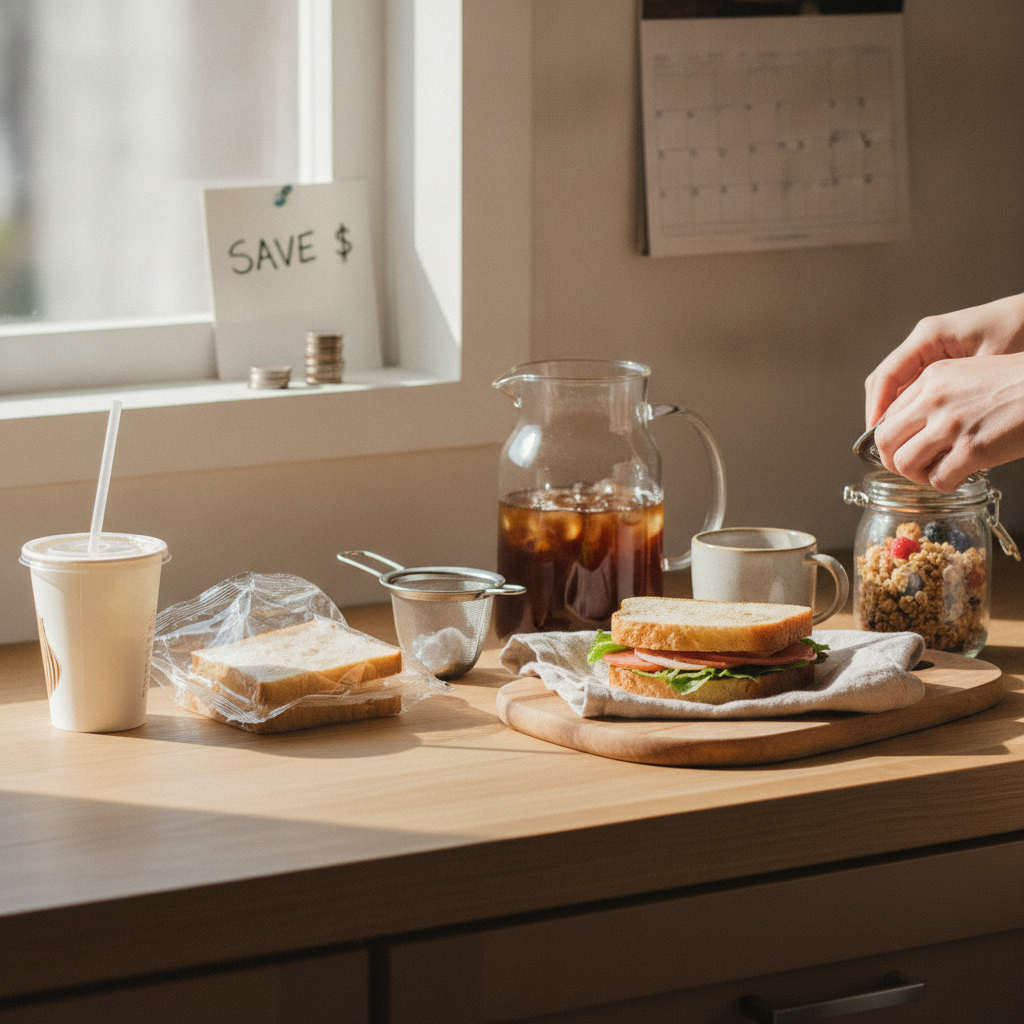
Small spending rarely announces itself. It arrives in paper cups, plastic bags, and the cheerful ping of a delivery notification — each transaction modest enough to feel inconsequential, yet collectively forming one of the more significant drains on a household budget. The phenomenon is well understood by behavioral economists and personal finance researchers alike: the friction of small, frequent purchases is low, which means the mental accounting we apply to them is equally minimal. A morning coffee here, a lunchtime sandwich there, a last-minute grocery run that somehow becomes a forty-dollar receipt — these moments compound in ways that quarterly budget reviews rarely capture. The insight that replacing just three of these habitual convenience purchases with simple home-based alternatives can recover more than a thousand dollars over twelve months is not a dramatic financial intervention. It is, instead, a quiet reckoning with the math of daily life.
The True Cost of Convenience Pricing
Convenience has always commanded a premium, but the gap between what something costs at the point of impulse versus what it costs when prepared at home has widened considerably. A specialty coffee drink purchased at a chain like Starbucks or a boutique café typically runs between five and eight dollars when tax and any tip are included. Prepared at home using a quality bag of beans from a roaster like Intelligentsia or even a store-brand equivalent, the same volume of coffee costs a fraction of that — often less than a dollar per serving. Across five mornings a week, that difference accumulates to roughly fifteen to twenty-five dollars every seven days. Over a year, this single substitution alone approaches the lower boundary of four figures, and that is before accounting for the mid-week top-up drinks that rarely appear in anyone's mental tally.
The pattern repeats with lunch. Purchasing a prepared meal from a deli counter, fast-casual restaurant, or food delivery platform like DoorDash introduces not just the menu price but often a delivery fee, a service fee, and the social expectation of a tip. Three purchased lunches per week, each averaging twelve to fifteen dollars all-in, represents a recurring expense that few households consciously budget for. The alternative — batch-preparing simple lunches on a Sunday evening, drawing on pantry staples and whatever produce was purchased during the week's main grocery run — compresses that cost dramatically without requiring culinary skill or significant time investment.
Habito, Hábito, and the Language of Routine
In Spanish and Italian, the word for habit — *habito* or *abitudine* — shares its root with the idea of dwelling, of inhabiting a space. There is something instructive in that etymology. Habits, in the truest sense, are places we live in, environments we create through repetition rather than conscious decision. The convenience purchase is itself a habit, which is precisely what makes it feel invisible. Nobody decides, morning after morning, to spend eight dollars on a latte as an act of deliberate budgeting. They simply follow the groove worn smooth by previous mornings. Replacing one groove with another — the home coffeemaker, the pre-packed lunch container, the meal planned before hunger strikes — requires less discipline than most people expect, because habits, once established, do their own maintenance. The initial investment in a decent home brewing setup, whether a French press or an entry-level espresso machine, pays for itself within weeks and then continues producing returns indefinitely.
The third category of convenience spending that yields meaningful savings when redirected homeward is the impulse grocery or household supply run. These are the mid-week trips to a pharmacy chain like CVS or a convenience store, where a forgotten item — paper towels, a bottle of shampoo, a snack — is purchased at a markup that can be thirty to fifty percent above what the same product costs at a warehouse retailer or bought in modest bulk during a planned shopping trip. Three such trips per week, each averaging ten to fifteen dollars, adds another layer to the annual figure. The fix is less about deprivation than about planning: a running household list, a weekly review of what is genuinely low, and the understanding that a slightly inconvenient delay until the next planned shopping trip is almost always worth the price difference.
When Small Shifts Produce Structural Change
What makes the three-substitution framework particularly durable is that it does not require renegotiating an entire lifestyle. It asks only that three habitual touchpoints — the morning coffee run, the weekday convenience lunch, and the impulsive supply errand — be replaced with equivalents that are prepared, packed, or purchased with marginally more intention. The cumulative effect, however, is not marginal. Households that track these substitutions carefully often find that the savings extend beyond the direct cost of the purchases themselves. Fewer trips to high-markup environments mean fewer exposure events to additional impulse items. The person who no longer stops at the corner shop for a snack is also not browsing the magazine rack or picking up a drink they did not need. Behavioral researchers call this the *exposure effect* — the degree to which physical presence in a retail environment predicts unplanned spending. Reducing those exposures is a compounding benefit that the arithmetic of the three swaps does not fully capture.
Cultivating home habits also tends to shift a household's relationship with food and consumption in ways that generate secondary savings. Someone who has begun making coffee at home is more likely to have invested, even modestly, in a quality kettle or grinder — and that investment changes their relationship with the ritual itself. The morning cup becomes something made rather than purchased, which subtly repositions it from transaction to practice. The same dynamic applies to prepared lunches: once the Sunday batch-cook becomes routine, it creates familiarity with ingredients and portion sizes that tends to reduce food waste, one of the more underappreciated sources of household financial loss.
Redirecting What You Recover
The thousand dollars or more recovered through these three shifts does not need to be managed with elaborate systems to be useful. It can simply sit in a high-yield savings account — institutions like Ally or Marcus have historically offered rates meaningfully above traditional checking accounts — where it accumulates passively while serving as either a buffer against unexpected expenses or a foundation for a goal that previously felt out of reach. For households already operating close to their income, even a modest cushion of this kind changes the calculus of minor financial shocks: the car repair, the medical copay, the appliance that fails without notice. The practical effect is not just numerical. It is the psychological shift from scarcity management to something closer to stability — and that shift, quiet as it is, tends to make every subsequent financial decision a little clearer.
The observation that small spending feels invisible because it is small is worth returning to here, because it also holds the answer. Visibility is the mechanism of change. Once the three purchases are named — the coffee, the lunch, the errand — and their weekly totals are made concrete, the decision to replace them with home-based alternatives stops feeling like sacrifice and starts feeling like recalibration. The convenience that these purchases offered was never really about the coffee or the sandwich. It was about the absence of friction. And friction, it turns out, is surprisingly easy to engineer out of a home routine — once you decide it is worth the effort to try.