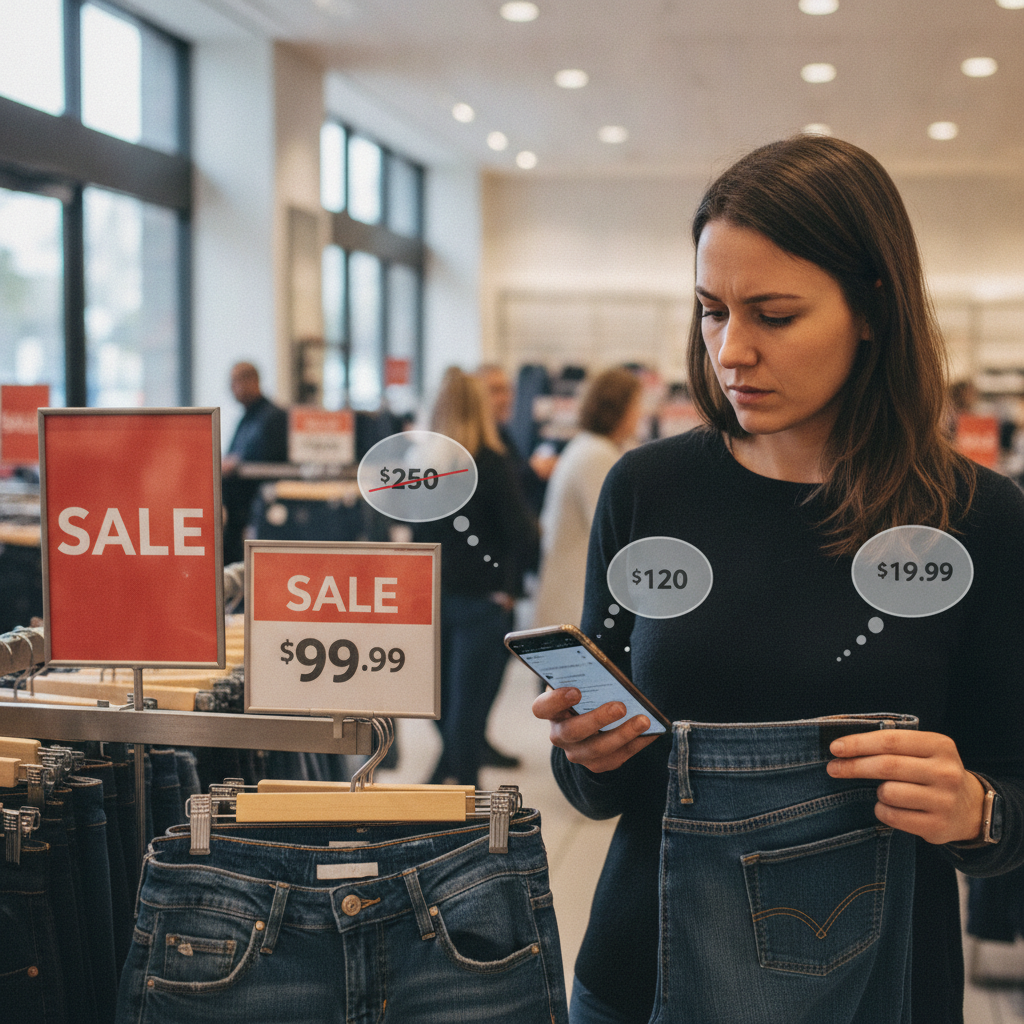
Retail environments are engineered spaces. Every price tag, shelf placement, and promotional banner exists within a carefully constructed system designed to shape how shoppers perceive value before they've had a moment to think critically about it. One of the most powerful tools in that system — and one of the least visible — is price anchoring: the practice of presenting a higher reference price alongside a sale price to make the difference feel like a gain. Understanding how it works doesn't require a background in behavioral economics. It requires only the willingness to slow down long enough to ask a few simple questions.
What Is Price Anchoring and Why Does It Work?
Price anchoring exploits a quirk in the way human cognition evaluates numbers. When people encounter a price, they don't assess it in isolation — they compare it to the nearest available reference point. Retailers know this, which is why a jacket marked "Originally $280, Now $140" feels like a bargain regardless of whether the jacket was ever actually sold at $280 or whether $140 is a reasonable price for that item at all. The anchor — that original figure — colonizes the shopper's frame of reference and distorts the judgment that follows.
The effect is remarkably durable. Studies across consumer behavior research have shown consistently that anchors influence purchasing decisions even when people are aware that the anchor exists. Knowing the trick, in other words, doesn't automatically neutralize it. The brain's tendency to use readily available numbers as reference points is fast and automatic, while the analytical thinking required to override it is slower and demands deliberate effort.
Retailers deploy anchoring in numerous forms beyond the simple strikethrough price. A restaurant menu might list a $95 entrée near the top not because it's expected to sell well, but because it makes the $52 dish below it feel moderate by comparison. A software subscription platform might display three tiers where the middle option seems like obvious value only because the premium tier exists to frame it. Apple and Amazon — two companies whose pricing strategies are studied constantly in retail circles — both use anchoring in distinct ways: Apple through aspirational flagship pricing that makes mid-range models feel accessible, Amazon through the "List Price" reference that accompanies millions of product pages, a figure the Federal Trade Commission has scrutinized at various points for its accuracy.
How Retailers Set and Display Reference Prices
The "original price" printed beside a markdown is not always what it appears to be. In many cases, it reflects a manufacturer's suggested retail price — a figure that may exist primarily as a legal and psychological construct rather than a price at which goods were genuinely sold at volume. In others, a retailer may briefly list an item at the higher price for a short window before discounting it, satisfying the technical requirements for labeling it "on sale" while maintaining an anchor that was never really a market price.
This practice is more widespread than most shoppers assume. The Federal Trade Commission's guidelines on price advertising require that a "former price" be a bona fide price at which a meaningful quantity of sales occurred, but enforcement is uneven, and the burden of investigation rarely falls on individual consumers. Retailers such as Kohl's have faced class action litigation over their reference pricing practices, with plaintiffs arguing that "original" prices were regularly set at levels that did not reflect actual market transactions. The legal outcomes of such cases vary, but they underscore a structural reality: the number crossed out above a sale price may carry less informational weight than it appears to.
Beyond the individual tag, the layout of the store itself reinforces anchoring effects. High-margin items placed at eye level or near entryways function as implicit anchors that recalibrate what shoppers expect to spend as they move deeper into the space. Electronics retailers frequently position premium items at the front of the category display for exactly this reason.
Three Checks That Reveal Whether a Discount Is Real
The good news is that a handful of practical checks can quickly puncture the illusion of a deal — and none of them require significant time or expertise.
The first check is price history. Tools like CamelCamelCamel track the historical pricing of Amazon listings with precision, showing exactly what a product sold for over weeks or months. A mattress listed at "40% off" that has been at the same sale price for five consecutive months is not on sale — it is simply priced at its normal retail level, framed with theatrical urgency. Google Shopping also surfaces price history data for many categories, and browser extensions like Honey log price changes automatically in the background while shopping. If the "original" price appears only rarely in the history or not at all, the anchor has no legitimate foundation.
The second check is cross-retailer comparison. An item marked down at one retailer may be available at a lower price, or the same price without the theatrical markdown framing, at a competitor. Target, Walmart, and Best Buy frequently carry overlapping inventory, and comparing current listed prices across platforms takes less than two minutes. A meaningful sale narrows the gap between a retailer's price and the broader market. A theatrical sale simply applies a strikethrough to a price that was never competitive in the first place.
The third check is the cost-per-unit calculation for consumables and bulk purchases. Warehouse retailers like Costco are expert at creating anchoring effects around large pack sizes — the perception that buying more means saving more. But the per-unit math doesn't always confirm that impression, particularly when comparing store-brand alternatives at conventional grocery stores. Dividing the total price by the quantity and comparing that figure across purchase options is the only reliable way to determine whether a bulk deal is genuinely better or simply larger.
When you apply these three checks before committing to a purchase, you shift from reacting to a number someone else chose to present and start evaluating the price on its actual merits. The process becomes habitual quickly, and the mental friction of doing it diminishes with practice.
Price anchoring is not going to disappear from retail environments — it is too effective and too embedded in how retail psychology functions. What will likely evolve is the consumer toolkit for countering it. Browser extensions, AI-assisted price tracking, and regulatory attention to deceptive reference pricing practices are all maturing simultaneously, and shoppers who build the habit of checking price history and comparing across retailers today are well positioned to benefit as those tools grow more sophisticated. The fundamental discipline, however, remains unchanged: treat every crossed-out number as a hypothesis worth testing, not a fact worth trusting.