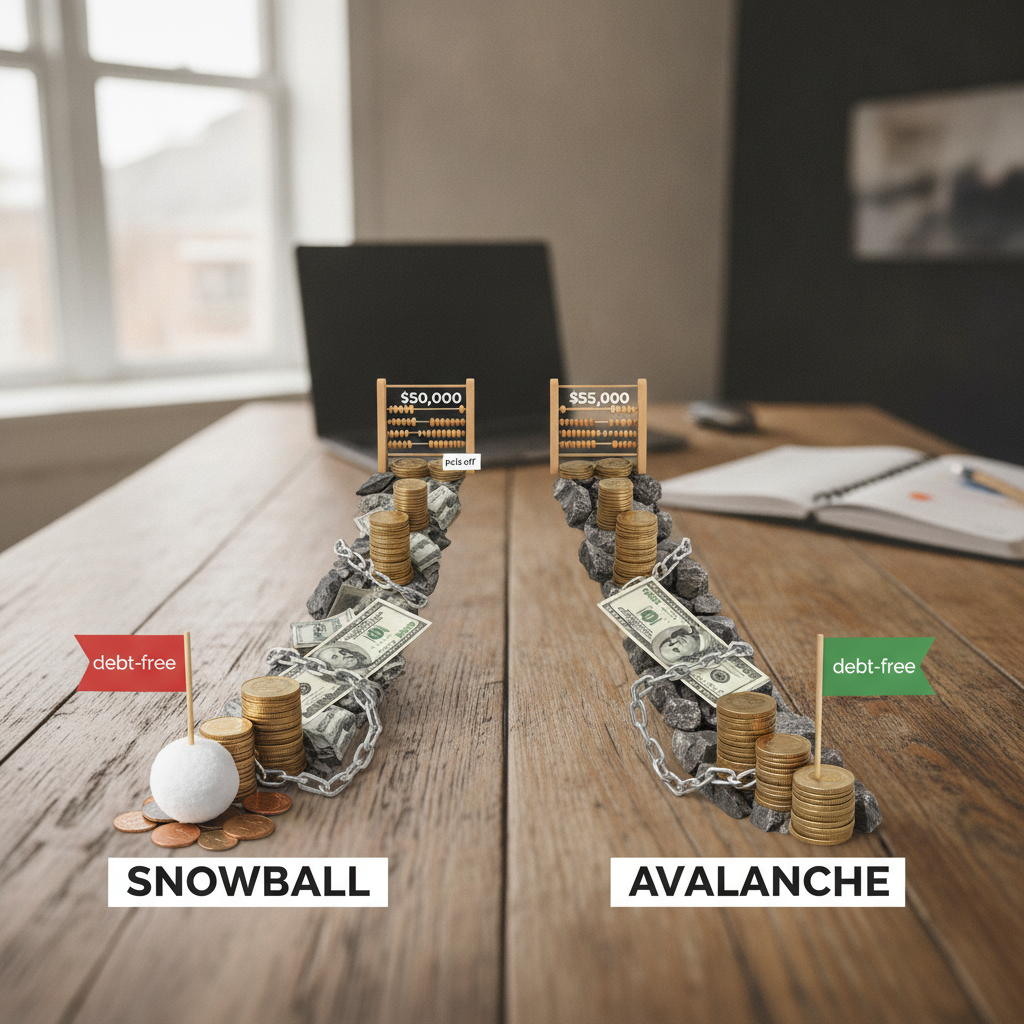
Two of the most widely recommended debt repayment strategies work on entirely different logic — and the difference between them can translate into months of extra payments and significant interest costs for the average borrower.
What Separates These Two Approaches at Their Core?
The debt avalanche method prioritizes debts by interest rate, directing every available extra dollar toward the balance carrying the highest rate while making minimum payments on everything else. The debt snowball method, popularized by financial educator Dave Ramsey, ignores interest rates entirely and targets the smallest balance first. Both strategies use the same core mechanic — once one debt is eliminated, the payment previously applied to it rolls into the next target — but the order in which debts get attacked is fundamentally different.
How Does the Avalanche Method Actually Save Money?
Because the avalanche approach eliminates high-interest debt first, less of each payment goes toward interest over time. Credit card debt commonly carries rates well into the high teens or twenties, while personal loans or medical debt might sit closer to ten or twelve percent. By targeting the most expensive debt immediately, the avalanche method reduces the total interest accruing across the entire portfolio with every passing month. The mathematical advantage is real and measurable: borrowers carrying multiple debts with meaningfully different interest rates can save hundreds to several thousand dollars over the full repayment period compared to the snowball approach.
What Makes the Snowball Method Appealing Despite the Cost?
The snowball method's appeal is almost entirely psychological. Eliminating a small balance quickly produces a visible, concrete win — one fewer account, one fewer bill, a tangible proof of progress. Research in behavioral finance consistently finds that people who experience early momentum are more likely to stay committed to long-term plans. For someone who has tried and abandoned repayment strategies before, that emotional reinforcement may matter more than marginal interest savings. The snowball doesn't pretend to be the cheapest path; it's designed to be the most motivating one.
How Do the Real Dollar Differences Play Out in Practice?
Consider a borrower holding three debts: a credit card at a high rate, a personal loan at a mid-range rate, and a small medical balance at a low rate. Under the snowball method, the medical bill gets cleared first, then the personal loan, then the credit card — leaving the most expensive debt accruing interest the longest. Under the avalanche, the credit card gets the extra payments immediately, cutting off the most damaging interest source from the start. The gap between these two outcomes narrows when balances are similar in size and rates are close together, but it widens considerably when one high-rate debt is significantly larger than the others.
Which Strategy Gets Borrowers Out of Debt Faster?
Pure speed of full debt elimination almost always favors the avalanche. Because it controls the total interest burden, borrowers typically reach a zero balance in fewer months — sometimes modestly, sometimes substantially, depending on the specific debt mix. Apps like Undebt.it and tools within platforms like Tally allow users to model both approaches side by side using their actual balances and rates, making the comparison concrete rather than theoretical. The snowball may occasionally match the avalanche's timeline when small balances happen to carry the highest rates, but that alignment is coincidental rather than structural.
Which Approach Should You Actually Use?
The honest answer depends on your relationship with financial discipline as much as it depends on math. If you've successfully stayed on budget before and can handle a longer runway before seeing your first payoff, the avalanche method is likely to save you the most money. Start by listing every debt with its current balance, minimum payment, and interest rate. Rank them from highest rate to lowest, then direct every spare dollar toward the top of that list while keeping minimums current on the rest.
If you've struggled with consistency, or if having a string of early wins would meaningfully increase your chances of staying the course, the snowball's psychological structure may outperform the avalanche in practical terms — even if it costs more on paper. Sort your debts from smallest balance to largest, ignore the rates, and attack them in that order.
Some borrowers also use a hybrid: they apply the avalanche logic except when a small balance is close enough to elimination that clearing it quickly costs very little extra in interest. Tools like Undebt.it and basic spreadsheet templates make this kind of custom sequencing easy to map out.
The method that gets a borrower out of debt is always better than the theoretically optimal method that gets abandoned at month three.
---
The debt avalanche and debt snowball ultimately serve the same goal through different means. The avalanche is the mathematically superior strategy for reducing total interest paid and reaching full debt freedom faster. The snowball trades some of that efficiency for early psychological rewards that help certain borrowers stay motivated over a long repayment arc. Understanding the real dollar difference between the two — and being honest about which behavioral tendencies apply — is what allows someone to choose the approach most likely to actually work for them.