There is a particular kind of traveler fatigue that arrives not from distance, but from speed. The traveler who has spent two weeks cycling through five cities — dragging luggage across train platforms, recalibrating to new time zones, speed-reading guidebooks in hotel lobbies — often returns home more exhausted than rested, their memories blurring into a single restless montage. The photographs are plentiful. The sense of having truly inhabited a place is not. This is the paradox that slow travel quietly resolves, and it does so while asking for something most modern itineraries refuse to offer: stillness.
The Economics of Staying Put
The financial logic of slow travel is straightforward once examined closely. Short stays trigger the most expensive pricing brackets across nearly every category of accommodation. Hotels, vacation rentals on platforms like Vrbo and Airbnb, and even private guesthouses almost universally reward guests who commit to longer stays with meaningfully lower nightly rates. A studio apartment in Lisbon's Mouraria neighborhood or a furnished flat in Chiang Mai's Nimman area might run at a high nightly rate for two or three days, yet drop to something substantially more manageable when booked for ten days or two weeks. Beyond accommodation, the savings compound. With access to a kitchen, even a modest one, the traveler escapes the near-daily expense of restaurant meals and begins shopping at local markets the way residents do — not as a tourist activity, but as a practical rhythm.
Transportation costs follow the same logic. The traveler who stays in one city for a week is not booking a new flight every few days, not paying for taxi transfers between airports and unfamiliar neighborhoods, not absorbing the hidden costs of constant movement. A weekly transit pass in most European or Southeast Asian cities costs a fraction of what repeated single-fare rides accumulate to over the same period. These are not dramatic windfalls but steady, compounding reductions — the kind that quietly reshape a travel budget without requiring any sacrifice of comfort.
What Familiarity Gives Back
The savings, though real and significant, are arguably secondary to what slowing down returns to the experience itself. There is a concept in Italian culture known as *il dolce far niente* — the sweetness of doing nothing — that captures something essential about what rushed travel forgets. It is not that slow travelers do less. They often do more, in the sense that matters: they become regulars at the corner café, they learn which market vendor has the best stone fruit, they begin to understand the rhythms of a neighborhood rather than merely photographing its surface. This kind of knowledge cannot be acquired in forty-eight hours, no matter how efficiently an itinerary is constructed.
The Japanese concept of *ma* — a meaningful pause, an intentional space between things — offers another frame for understanding slow travel's value. When an itinerary is packed with consecutive destinations, there is no *ma*, no breathing room for an unexpected afternoon, a conversation with a neighbor, a detour down an unmarked street. These unplanned moments are frequently what travelers remember most vividly years later, yet they require the one resource that budget-conscious itinerary-building tends to eliminate first: time.
The Practical Shape of a Slow Trip
Organizing a slow travel experience involves less planning in some respects and more intentionality in others. Choosing the right base matters enormously. A walkable neighborhood with a local market, a transit connection to nearby points of interest, and a mix of residential and commercial life will serve a week-long stay far better than a central tourist district, which tends to be expensive, loud, and oddly disconnected from how the city actually functions. In Barcelona, the Gràcia district offers this balance. In Tokyo, neighborhoods like Yanaka preserve a quieter, more residential character that reveals itself slowly. In Mexico City, Condesa and Roma are well-known, but staying long enough to move between them on foot, rather than by rideshare, changes the experience entirely.
Booking tools like Airbnb, local guesthouse networks, or even direct apartment rental agencies often surface the best long-stay rates when searches are filtered to ten or more nights. Travelers who reach out directly to hosts before booking frequently negotiate better terms, particularly in the off-season. The conversation itself — the small negotiation, the exchange of practical information about the space — begins the process of arriving somewhere rather than simply appearing in it.
Spending Less by Living More Like a Local
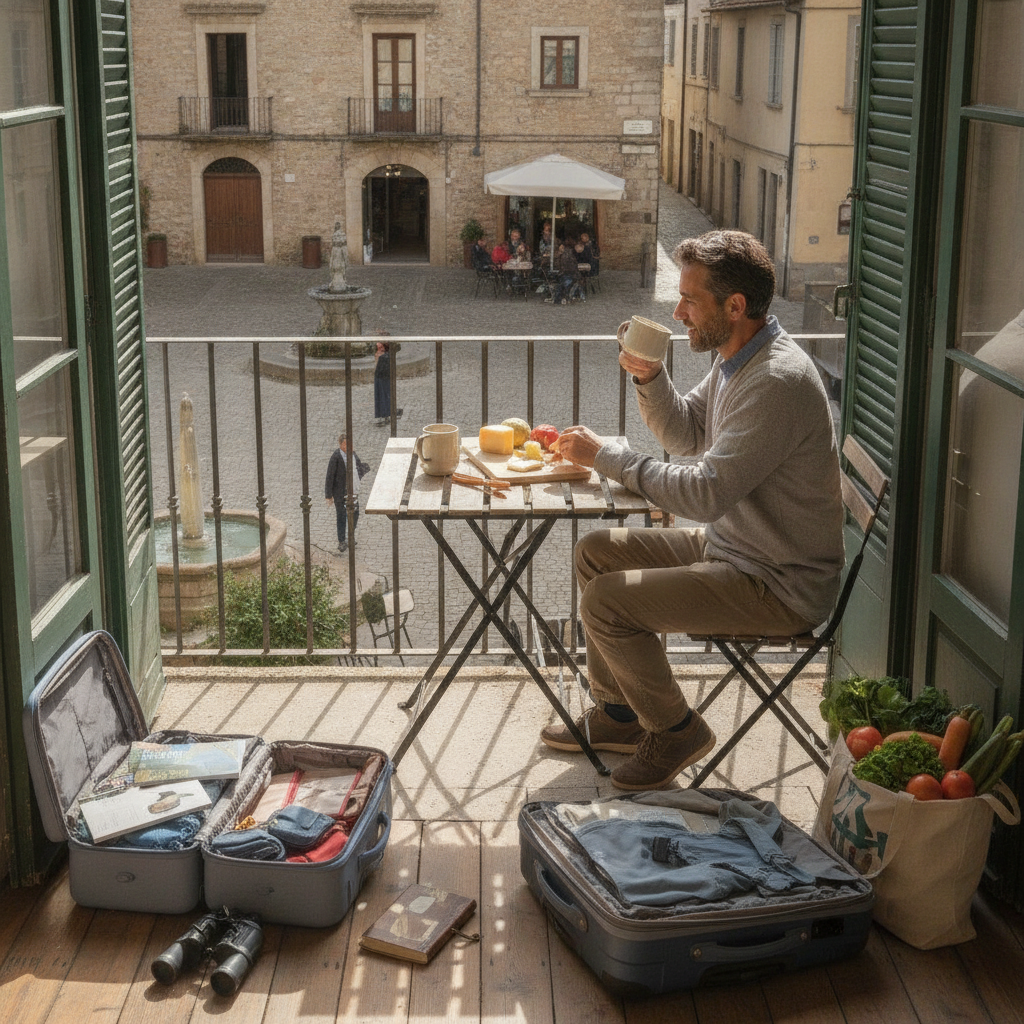
One of slow travel's most reliable cost advantages arrives through grocery shopping, a habit that transforms from a chore into a genuine cultural encounter. Farmers' markets in Provence, covered mercados in Oaxaca, wet markets in Penang — these are not tourist attractions in the conventional sense, though visitors do wander through them. They are working markets where prices reflect local purchasing power rather than tourist-zone markup. A traveler with even a rudimentary kitchen and the willingness to cook a few meals a week will find the savings substantial, and the experience of selecting unfamiliar produce, asking a vendor how to prepare it, and eating the result at a small rented table is among the most genuinely immersive things travel can offer.
The Slower Return
When you finally leave a place you've stayed in for a week or more, the departure feels different — heavier in a good way, like something was actually exchanged rather than merely observed. You know which bakery opens earliest, which route home from the market avoids the midday heat, which neighborhood sounds shift between Tuesday and Saturday. The city has left a small imprint, and you have left some trace in it. This is the quality that rapid itinerary travel rarely produces, and it is, in the end, what most people are searching for when they travel at all. The traveler who arrived exhausted from the pace of moving through five places in two weeks, who opened this reflection on restlessness and blurred memories, is not a cautionary figure — just someone who hadn't yet discovered that the best way to afford a trip, in every sense of the word, is often simply to slow down.