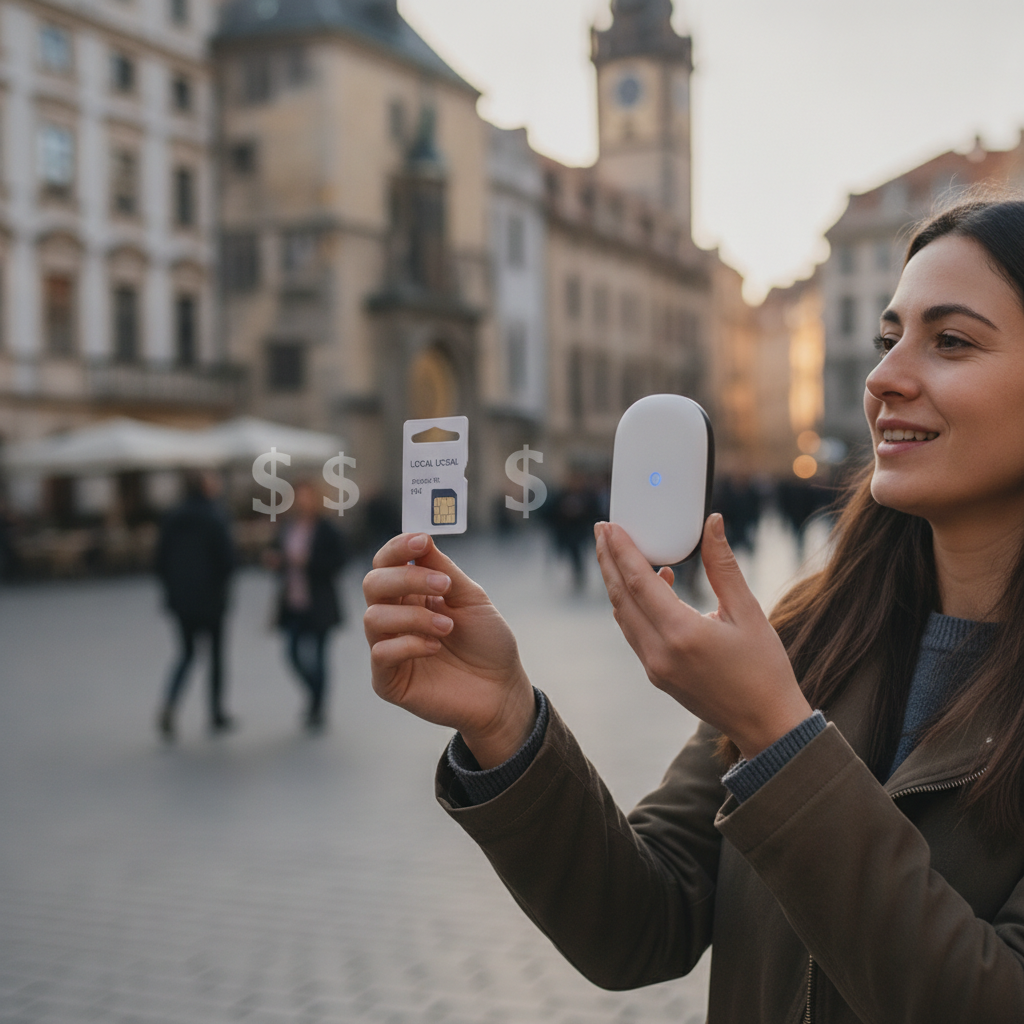
International roaming charges remain one of the most reliably unpleasant surprises in travel — a bill that arrives after the trip, making an already-expensive vacation feel worse in retrospect. Carriers have long marketed roaming plans as the convenient solution, and they are convenient, but convenience rarely comes cheap. For most international travelers, renting a local SIM card or a pocket Wi-Fi device at the destination is a straightforward alternative that cuts connectivity costs dramatically without meaningfully sacrificing the experience.
The Real Math Behind International Roaming Plans
Most major carriers — including AT&T, Verizon, and T-Mobile in the United States — offer international roaming add-ons that sound reasonable until the fine print gets examined. A typical plan might charge a daily flat rate for access or throttle speeds after a modest data threshold. When spread across a ten-day trip, those daily fees compound quickly. The more significant issue is that roaming plans are priced for the traveler's home market, not the destination country, meaning the carrier captures a wide margin that a local provider simply doesn't need to charge. Travelers often pay two to three times more per gigabyte through a roaming add-on than a local SIM in the same city would cost.
How Local SIM Cards Work and Where to Find Them
A local SIM card is a small chip sold by a carrier in the destination country that gives a phone a temporary local number and access to local data rates. In most major travel destinations — Japan, Thailand, the United Kingdom, France, Mexico — local SIMs are sold at airports, convenience stores, and dedicated phone shops for the equivalent of a few dollars, with data packages included. The process takes minutes: insert the SIM, follow a brief setup, and the phone connects to local infrastructure at local prices. The trade-off is that the traveler's regular number becomes temporarily unavailable for calls and texts, though messaging apps like WhatsApp and iMessage still work over data, making the limitation far less significant than it sounds.
Pocket Wi-Fi Devices as a Group-Friendly Option
For travelers who prefer not to swap out their SIM card, or who are traveling in a group, a pocket Wi-Fi device — sometimes called a mobile hotspot or MiFi — offers a compelling alternative. These compact devices connect to local cellular networks and broadcast a personal Wi-Fi signal that multiple devices can share simultaneously. Rentals are widely available at major international airports, including Tokyo's Narita, London's Heathrow, and Bangkok's Suvarnabhumi, often bookable in advance online through services like Klook or directly through local telecom providers. For a group of three or four sharing one device, the per-person cost drops to levels that make roaming plans look almost absurd by comparison.
What to Know Before You Land
A few practical considerations make the process smoother. First, confirm the destination phone is unlocked — a locked handset purchased through a carrier may refuse a foreign SIM. Most modern unlocked smartphones handle this effortlessly, but it's worth checking before departure. Second, research data needs honestly: light travelers who primarily use maps and messaging need far less data than someone who streams or uploads constantly, and most destinations offer tiered packages that reflect this range. Third, read the activation instructions before arriving exhausted from a long flight. Most local SIMs include printed setup steps, but having the process reviewed in advance avoids confusion at the airport.
The Hidden Costs Roaming Plans Don't Mention
Beyond the headline daily or monthly fee, roaming plans often carry costs that only emerge during billing. International calls made through a roaming plan frequently incur per-minute charges on top of the base fee. Receiving calls from home can trigger charges. Going slightly over a data cap can trigger automatic upgrades to a higher tier, or worse, per-megabyte overage rates that accumulate invisibly. A local SIM or pocket Wi-Fi eliminates most of these variables entirely — the traveler pays a flat, predictable amount upfront and uses data within that bucket without worrying about surprise charges. That predictability alone changes the travel experience in ways that are harder to quantify but easy to appreciate.
Where This Approach Fits Into a Smarter Travel Budget
Connectivity is a fixed cost on nearly every international trip, but it doesn't have to be an inflated one. For you, the calculation is simple: compare the total cost of your carrier's roaming add-on for the trip duration against the cost of a local SIM or pocket Wi-Fi rental at the destination. In most cases, the local option wins clearly — often by fifty percent or more, sometimes by a greater margin in destinations where local data is exceptionally cheap, like Southeast Asia or parts of Eastern Europe. Booking a pocket Wi-Fi device through Klook or a similar platform before departure guarantees availability and usually locks in a lower price than airport walk-up rates. For longer trips, a local SIM from a destination carrier like True Move in Thailand, EE in the UK, or Telcel in Mexico typically offers the best value per day.
The broader shift happening in travel connectivity is worth watching. eSIM technology — where a virtual SIM is downloaded digitally without swapping any physical card — is making the process even simpler. Services like Airalo already let travelers purchase destination data packages before departure and activate them on arrival, and as more phones support eSIM natively, the case for paying roaming premiums weakens further. Carriers know this, which is why some have begun adjusting their international offerings, but the structural cost advantage of local providers is unlikely to disappear. Travelers who build connectivity costs into their trip planning early — rather than defaulting to whatever their home carrier offers — consistently walk away paying less and experiencing no meaningful drop in service.