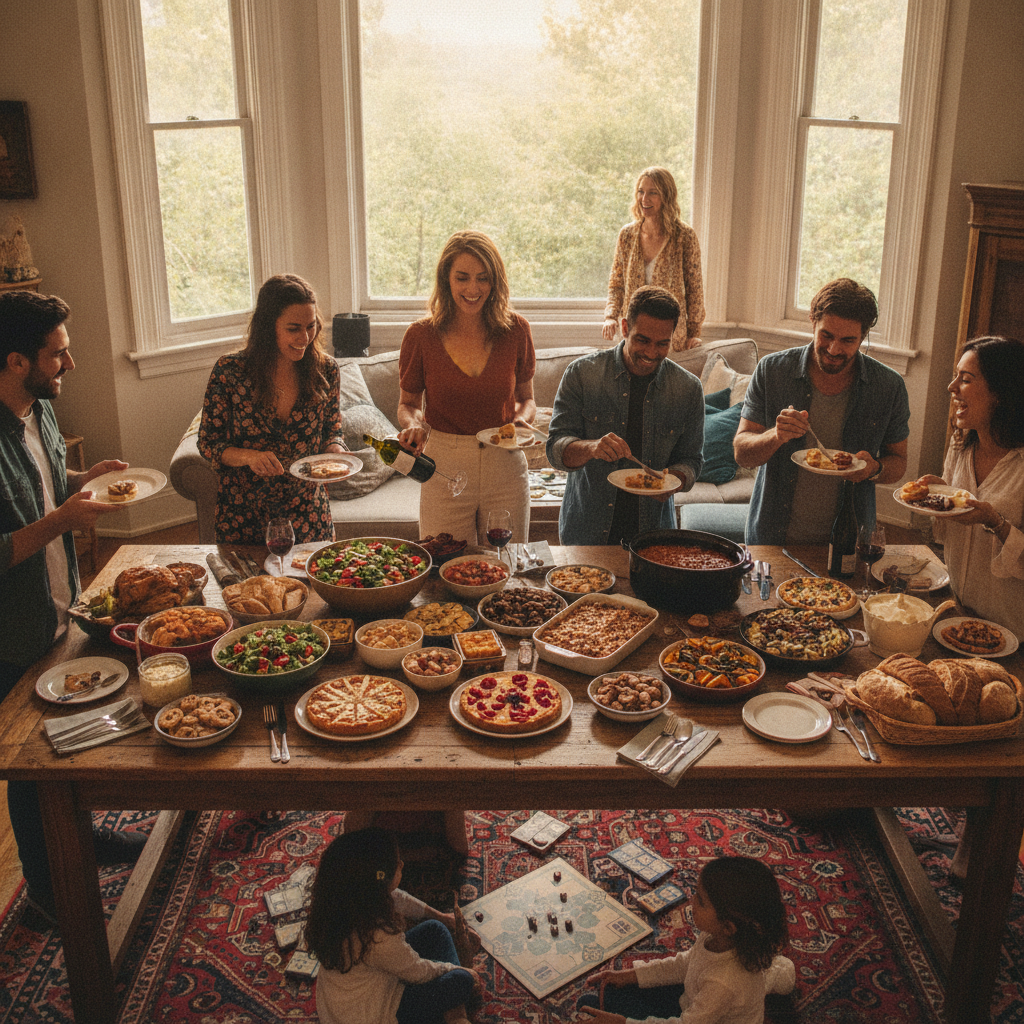
There is something almost paradoxical about the way modern social life has quietly outsourced its most intimate rituals to restaurants. Gathering with people you love — a gesture that is, at its core, about presence and conversation — has become structured around reservations, prix fixe menus, and bills that arrive before anyone is ready to leave. The potluck, by contrast, is one of the oldest and most quietly radical alternatives available: a form of hosting that distributes both the labor and the cost across everyone invited, while producing something no restaurant can replicate — a table assembled entirely from the hands of the people sitting around it.
The Economics of Gathering Around a Shared Table
The math behind a regular dining-out habit is rarely examined closely, and that is precisely where its costs accumulate. A group of four at a mid-range urban restaurant — somewhere like a neighborhood bistro in Chicago's Wicker Park or a casual Italian spot in Portland's Pearl District — can easily spend between sixty and a hundred dollars per couple before drinks are totaled. Do that twice a month across a social circle of six or eight people, and the monthly outlay becomes significant without ever feeling deliberate. Potluck hosting restructures that entirely. When each household brings one dish, the per-person contribution drops to roughly the cost of ingredients for a single recipe — often a fraction of what a single restaurant entrée would cost. The savings are not marginal; they are structural, built into the format itself.
What makes this shift particularly durable is that it does not require anyone to sacrifice the experience of gathering. The potluck's social texture is, in many ways, richer than a restaurant meal. There is something to talk about — who made what, where the recipe came from, whether the spice level was intentional. Apps like Potluck Planner or shared Google Sheets can coordinate dishes so the table lands with balance rather than four pasta salads and nothing else. The logistics are simpler than they appear, and the conversation they generate tends to be warmer.
What Gets Lost When Dining Out Becomes the Default
The *mise en place* of restaurant culture — a French culinary term referring to the careful preparation and arrangement of ingredients before service begins — has its equivalent in home hosting, and both produce a kind of intentionality that elevates a meal. But when dining out becomes the reflexive choice for every weekend gathering, something quieter is lost: the sense that the host has invested something personal in the occasion. A restaurant meal is an experience purchased; a potluck is an experience built. The distinction sounds sentimental until you notice how different the conversations feel, how much longer people tend to stay, how much less formal the whole thing becomes.
There is also a subtler financial dynamic at work. Restaurant environments are designed — through lighting, menu placement, and the rhythm of service — to encourage spending beyond what guests initially intend. A round of appetizers ordered while waiting for a latecomer, a bottle of wine that seemed reasonable at the time, a dessert split four ways that appears on the bill as its own line item: these are not accidental additions. They are features of the dining-out experience. Home hosting removes the architecture of upselling entirely. The wine brought by a guest costs what it costs; there is no markup, no corkage fee, no suggestion from a server trained to recommend the second-most-expensive option.
Building a Rotation That Sustains the Ritual
One of the quiet advantages of potluck hosting is how naturally it lends itself to rotation. When the responsibility of hosting moves around a friend group — one household one month, another the next — the effort and cost distribute evenly, and no single person carries the weight of always being the one with the table large enough to seat everyone. This kind of *tournus*, a term used in medieval guild traditions to describe the rotation of duties among members, has an almost intuitive logic to social circles that embrace it. It removes the unspoken pressure of reciprocity that often makes hosting feel like a debt to be repaid rather than a gift freely given.
For households new to this rhythm, the practical starting point is simple: choose one weekend a month to host or attend a potluck gathering in place of a restaurant outing that would otherwise have been the plan. Track the difference in what you spend over three months. The gap tends to be clarifying — not because the numbers are shocking, but because they make visible a spending pattern that previously felt invisible. Retailers like Trader Joe's and Costco have built entire categories around the contribution dish economy: easy, crowd-friendly formats that travel well, require minimal equipment, and cost less per serving than almost any comparable restaurant option.
The Deeper Shift in How You Value Your Social Time
Potluck hosting, when it becomes a genuine habit rather than an occasional novelty, tends to change something subtler about how people relate to their social spending. The gathering becomes the point, rather than the venue. Friends who previously met only at restaurants begin to know each other's kitchens, their cooking styles, their tendency to bring something ambitious or reliably crowd-pleasing. The social life becomes more layered, more textured, more genuinely personal — and it costs roughly half what it did before, not through deprivation, but through redirection.
This is, in the end, what the best spending shifts share: they don't ask you to want less. They ask you to want differently. The ritual of gathering on weekends, of sharing food and time with people you choose, is not diminished by moving it from a restaurant to someone's dining room. If anything, it returns to what it always was before dining out became the default — something made rather than purchased, given rather than ordered, and remembered not for what it cost, but for what it felt like to be there.