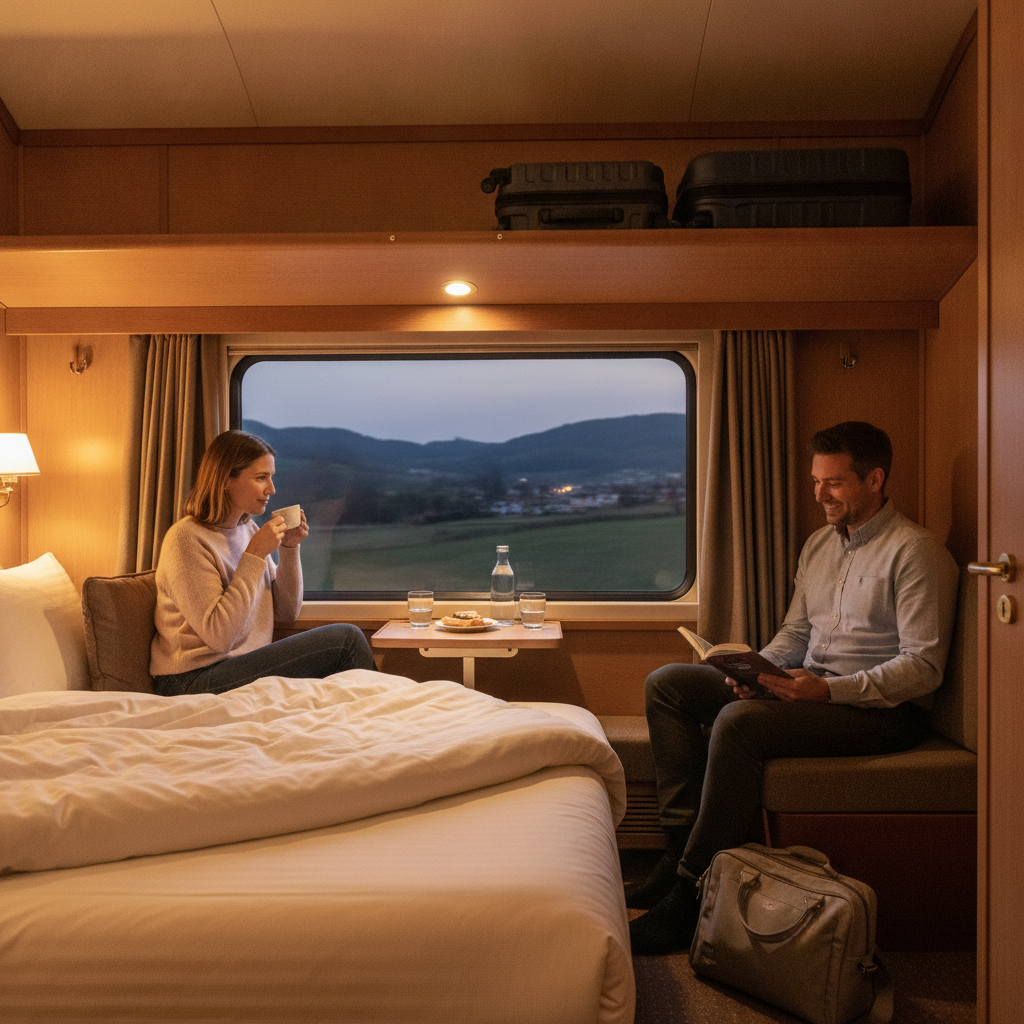
Long-distance travel has always involved a fundamental trade-off between speed, cost, and comfort — but the conventional assumption that budget flights automatically represent the cheapest option deserves closer scrutiny. Travelers who reach for a low-cost airline booking as their default move are often overlooking a compellingly efficient alternative: the overnight sleeper train, which quietly folds an entire night of accommodation into the price of the journey itself.
The Hidden Math Behind Overnight Rail Travel
At first glance, a budget flight fare can appear dramatically cheaper than a sleeper train ticket. The calculation shifts considerably, however, once the full cost picture comes into view. A budget flight typically demands a night in a hotel before or after travel — particularly given early departure times and the distance of low-cost airports from city centers. Add ground transportation, checked baggage fees, and the cost of meals in transit zones, and the apparent savings begin to erode. An overnight train, by contrast, lets travelers sleep through the journey, arriving at a central city station refreshed and ready, with one full night of accommodation effectively absorbed into the fare.
Comfort Differences That Compound Over a Long Trip
Budget airlines have refined the art of minimizing passenger comfort in ways that become increasingly apparent on long-haul legs. Narrow seats, restricted recline, expensive onboard food, and the general stress of airport environments add a fatigue cost that doesn't appear on any receipt but accumulates meaningfully over a multi-week itinerary. Overnight trains on routes like the Vienna–Venice corridor, the Paris–Barcelona Trenhotel alternative, or Amtrak's California Zephyr across the American West offer private compartments, fold-flat berths, and dining car experiences that transform transit time into rest time. For travelers on extended trips, arriving well-slept rather than exhausted can meaningfully affect how much they enjoy and spend at the destination itself.
Which Routes Make the Strongest Financial Case
Not every overnight train route delivers equivalent value, and identifying the strongest candidates requires matching journey length against available sleeping classes. Routes covering roughly six to ten hours overnight are typically the sweet spot — long enough to justify a sleeper berth but not so extended that the ticket price approaches a business-class flight. European rail corridors through Railjet and Nightjet services, operated by Austrian Federal Railways (ÖBB), represent some of the most well-developed overnight networks, connecting cities like Zurich, Amsterdam, Hamburg, and Vienna on single bookings. In North America, Amtrak's long-distance routes between Chicago and New Orleans or Seattle and Los Angeles serve a similar function, though scheduling and reliability vary by line.
Booking Strategy and Sleeping Class Selection
The value equation depends heavily on which sleeping class is selected at booking. Most overnight trains offer three tiers: a couchette with a basic fold-down bunk in a shared compartment, a more private second-class sleeper with linens and sometimes breakfast included, and a first-class private cabin that approaches the comfort of a modest hotel room. For solo travelers focused on maximizing savings, the couchette is typically the pragmatic choice — it replaces a hostel bed and eliminates an airport taxi in a single transaction. Couples or small groups often find that booking a private compartment divides neatly into a per-person cost that competes directly with mid-range hotel rooms while including the transit itself. Platforms like Rail Europe and the Trainline make it straightforward to compare available classes across European routes.
Environmental and Experiential Dimensions Worth Weighing
Beyond the financial case, overnight train travel carries experiential qualities that budget air travel structurally cannot replicate. Watching a landscape shift from lowland to mountain to coast across the arc of a night and morning is, for many travelers, a genuinely memorable part of the journey rather than dead time to endure. The environmental differential is also substantial — rail travel produces a fraction of the carbon emissions per passenger-kilometer of short-haul aviation, a consideration that has begun to influence itinerary decisions among a growing segment of travelers. These factors don't appear in a fare comparison, but they contribute to what travel actually delivers in terms of experience and satisfaction.
Practical Steps for Planning Your First Sleeper Leg
If you're building an itinerary that includes a journey of five hours or more between cities, it's worth running the full cost comparison before defaulting to a flight search. Start by identifying whether a viable overnight rail connection exists using a tool like Seat61.com, which maps available overnight routes globally with unusual clarity. From there, price the sleeper fare including your preferred sleeping class, then add the realistic total cost of the equivalent flight — including airport transfers, any bag fees, and a night of accommodation on either end. In most cases, you'll find the overnight train comes within striking distance of the flight's true cost or beats it outright. Book early for the best berth availability, and consider mixing overnight legs with daytime scenic trains on the same trip to get the most varied use of a rail pass where applicable.
The fundamental insight behind overnight train travel is straightforward: a journey that doubles as accommodation is inherently more efficient than one that doesn't. Travelers who build this logic into their itinerary planning consistently find that the apparent premium of a sleeper berth dissolves when measured against what it actually replaces — and that the journey itself becomes one of the more memorable parts of the trip.